Defying the Odds: Rusty Patched Bumblebee Spotted at Riverside Park
As the Air Quality Index (AQI) in Milwaukee reached 635, something beautiful happened: a rusty patched bumblebee was spotted at Riverside Park. The significance of the day was twofold; the previous AQI record in Milwaukee was 300, set in 1987, and the last time a rusty patched was seen at Riverside Park was 2020.
Thursday, July 16th , 2026, will be a day that sticks with me for a very long time. After a week of heat indexes reaching 100°F and Canadian wildfire smoke blanketing the region, my climate anxiety was at an all-time high. There is something uniquely unsettling about breathing smoke from fires hundreds of miles away. It is a powerful reminder that environmental problems do not respect borders and that the choices we make, whether they help or harm the planet, ripple far beyond our own communities.
With that mindset in tow, the Urban Ecology Center (UEC) Research Team and their N95 masks headed to the Milwaukee Rotary Centennial Arboretum to survey for bumblebees. We had been doing these surveys at all three UEC branches for the previous two weeks in search of rusty patched bumblebees, with no luck. Regardless of the otherwise cancelled programming due to the smokey air, we knew we still had to go out and check, even if it was only for a few minutes.
Not spotting a rusty patched over the previous weeks was no surprise to the team. Rusty patched bumblebees were added to the Endangered Species List in 2017 after an estimated 87% of their populations declined and they were found in less than 8% of their historical range. The species decline is from a number of factors including habitat loss, pathogens, pesticides, climate change and now genetic issues derived from breeding among a significantly reduced population. Combining those elements with the fact that spotting a tiny, buzzing creature and properly identifying it is incredibly difficult, there was no expectation of seeing this bee on our survey.
Well, leave it to a critter smaller than a cotton ball to provide much-needed optimism that we will carry with us for a long time.
About 10 minutes into our 15-minute survey that encompasses peering into bushes, searching for and identifying bumblebee species, Amanda Tokuyama, GIS and Field Data Manager, shouted, “Guys! I think I’ve got a rusty patched!”
Almost immediately, Maggie Steinhauer, Research Manager, responded, “Please tell me you got a picture.”
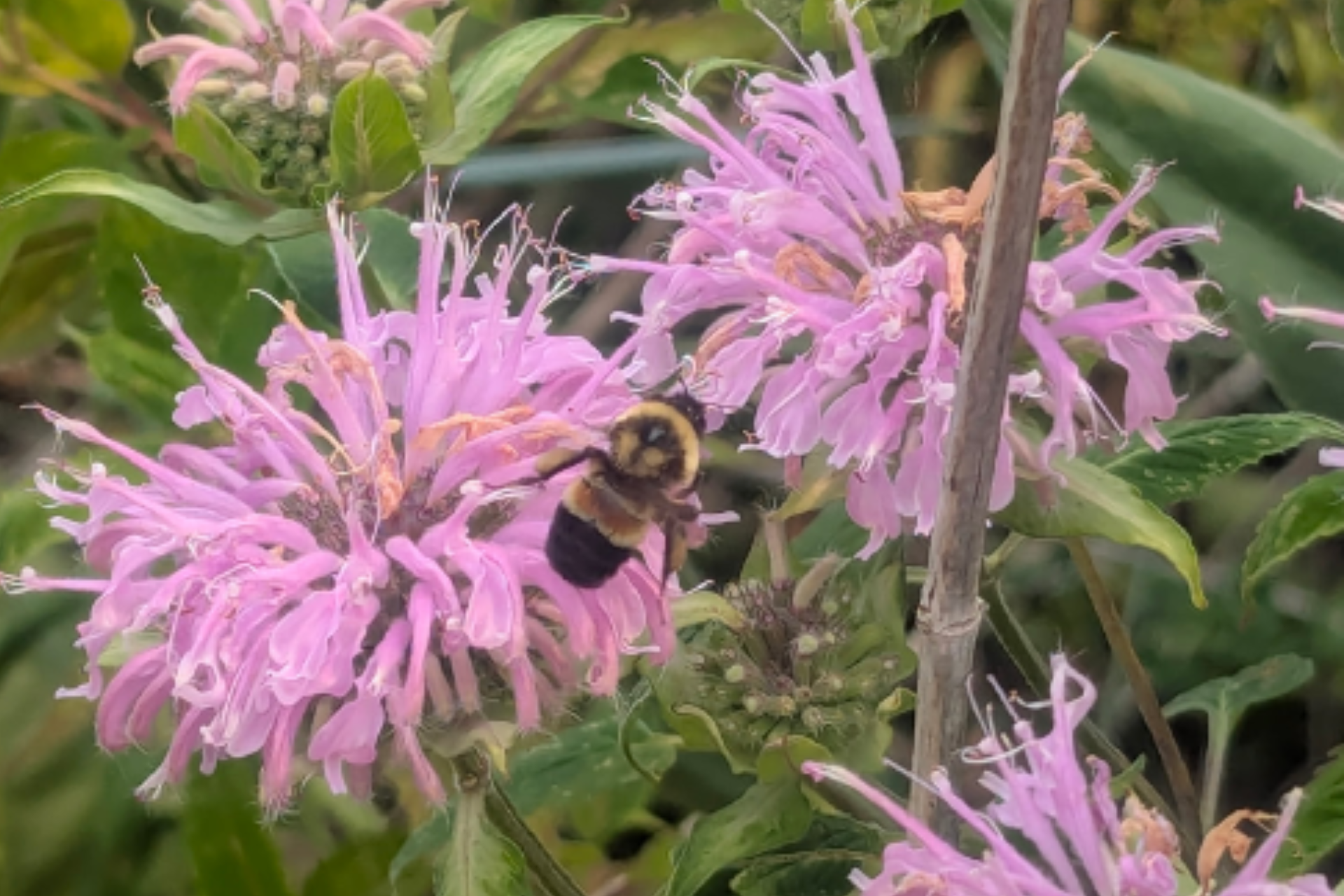
Tokuyama walked over to Steinhauer and presented the photo evidence on her phone. After consulting a bumblebee field guide and the UEC community scientist, Jen Lazewski, Steinhauer confirmed, “We’ve got a rusty patched.”
On a day when the atmosphere could not have felt more apocalyptic, encountering something so special was surreal. It was weirdly difficult to identify the correct feeling that swirled inside me. Sure, it was just one small insect we had seen, but it was so much more than that. It was hope.
Hope, as an environmentalist, has become increasingly difficult to hold onto.
Hope that the work being done at the Urban Ecology Center and similar organizations is making an impact in a world that too often prioritizes the immaterial.
Hope, that a small bee can provide the inspiration to keep fighting.
Hope.
Donate to the Urban Ecology Center to continue research work.


.jpg)
.jpg)
.jpg)